Blog
Monday, August 15, 2016 - 18:01
As if I didn't have enough plates spinning in mid-air, I've started doing a monthly column at Queer Sci Fi, focusing on motifs, tropes, and echoes of queer fantasy themes in historic literature. The venue gives me a chance to branch out a bit from the women-centered research I discuss for the Lesbian Historic Motif Project. In fact, for the debut column, I've gone quite far afield from my usual work and discuss the implicit themes of shape-shifting same-sex relationships and "male" pregnancy in the Fourth Branch of the Mabinogi. I'll be interested to see what people think of that spin!
View comments (0)
Monday, August 15, 2016 - 10:00
I've been teasing about this for a little while and now I can announce it officially. The Lesbian Historic Motif Project will now include the Lesbian Historic Motif Podcast, part of the Lesbian Talk Show Podcast, a magazine-style podcast that includes reviews, discussions, readings, and news from a variety of contributors and is created and hosted by the folks at The Lesbian Review. To begin with, I'll be contributing a monthly episode to be posted on the last Saturday of the month. If the material and my workload allows, it may eventually increase in frequency.
I'm rather excited about this development. I'd informally discussed the idea of a podcast about a year ago, but friends of mine who have done their own podcast convinced me it wasn't something I wanted to try on my own. So when The Lesbian Talkshow expanded from its original format to include multiple contributors, I floated the idea to them and immediately got back the response that they'd been thinking of asking me the same thing! At the time, I decided that if I could put together ten initial episodes, then I'd commit to it. It took me a little while to free up enough time to learn the Audacity software and to settle on what sort of content I wanted to include. In the end, when I had the first four episodes recorded, I decided that was good enough to go live.
The podcast is going to take a slightly different angle than the blog. The blog is very much organized around reviews and summaries of specific scholarly publications. The podcast is going to focus on people, on stories, on the "human interest" angle. Each episode will take off from a specific historic individual or fictional character and talk about who they were--their historic context and significance. It will be an opportunity to include some longer readings of historic texts than would have worked well in the blog. Imagine, for example, a dramatized readers' theater excerpt from Lyly's Gallathea! I'll also have a chance to synthesize information from multiple publications to present a more informal take on the subject matter. Eventually, I have some ideas for possible interviews to include.
My hope is that this will be a chance to bring the LHMP research to a new audience and to expand the diversity of coverage in The Lesbian Talk Show. You can subscribe to The Lesbian Talk Show via iTunes, Stitcher, or Podbean, or listen to individual episodes at their website. I'll post a reminder and link each time a new episode comes out.
Full citation:
Eriksson, Brigitte. 1985. “A Lesbian Execution in Germany, 1721: The Trial Records” in Licata, Salvatore J. & Robert P. Petersen (eds). The Gay Past: A Collection of Historical Essays. Harrington Park Press, New York. ISBN 0-918393-11-6 (Also published as Journal of Homosexuality, Vol. 6, numbers 1/2, Fall/Winter 1980.)
Publication summary:
A collection mostly of case-studies of specific historic incidents or topics relevant to the changing understandings of homosexuality. Most of the papers address male topics. Only the three relevant to female topics are covered in this project.
Eriksson, Brigitte. 1985. “A Lesbian Execution in Germany, 1721: The Trial Records”
I still remember a conversation I had, quite some time ago, with a relative who was a social worker. She primarily worked with "troubled youth" who were in the system due to psychological or behavioral problems. Knowing that I'm a lesbian, she commented something to the effect (highly paraphrased) of, "I know that homosexuality is a mental disorder because everyone I work with who's gay is completely messed up." To which I replied, "Everyone you work with is completely messed up." My observation was, of course, over-broad, but hers was ignoring the highly skewed nature of her selection process. It's the same skewing that led the early sexologists--who often worked with people who were seeking treatment for unrelated psychological issues--to pathologize all same-sex desire.
Researching queer people in history has a bit of the same problem. When a group of people are marginalized and stigmatized, the contexts in which the nature of their marginalization is mentioned are going to be highly skewed towards the negative. Most of the clear and unambiguous medieval European data on women having sex with women comes from legal cases in which at least one of the women was on trial for that behavior. But that doesn't mean that every (or even most) such couples were prosecuted and punished. Nor does it mean that the types of behavior that triggered prosecution were universal or even necessarily typical for women who loved women. For example, both penitential literature and the discussions around these legal cases suggests that the use of dildos and gender disguise were more strongly condemned than other types of homoerotic activity. So the focus of trials on those types of activity may simply mean that those were the ones most likely to be prosecuted. Similarly, prosecutions for same-sex relations that involve violent behavior may simply be the cases most likely to have been pursued, rather than a correlation between same-sex relations and violence.
It's in this context that we should consider the case of Catharina Margaretha Lincken. Unless one believes that a certain religious hysteria (and mercenary cynicism), as well as domestic conflict are necessary conditions for a same-sex relationship, one must suppose that other, less tragic, couples existed in the same time and place, well under the legal radar. Lincken was a troubled individual with a complex history. But there were many more troubled individuals in 18th century Germany who didn't share her sexual orientation. The case is highlighted for us because a late 19th century sexologist found it useful to support his theories of sexual pathology. Viewed more neutrally, without the filters of prejudice, it is a fascinating, if ultimately tragic, story of someone who was out of step with her society in several different ways, and whose sexual transgressions may have been only the last straw for the authorities, rather than the primary offense.
This is a translation of an 1891 publication of the summary of German trial records from1721. The 1891 publication is by Dr. F. C. Müller, a sexologist who added his own commentary from the point of view of sexual psychopathology. Eriksson’s translation omits this commentary and includes only the original trial summary. The summary was put together after the conclusion of the trial when the sentence was being sent to a higher authority for review. The history of the two defendants is long and complicated and touches on trangressions of religion, theft, and fraud, as well as the sexual allegations. There is some confusion of identity in the text, as both women are referred to as “defendant” and the descriptions sometime devolve into chains of she said/she said and she did/she did. But in general, Lincken is framed as the primary transgressor and Mühlhahn as the deceived innocent. As both women have the forenames “Catharina Margaretha” I have referred to them by their surnames.
Catharina Margaretha Lincken was 27 at the time of the trial. She was illegitimate (her mother was a widow) and she was raised in an orphanage in Halle. Her mother was aware of her whereabouts and activities, at least to some extent, and continued to be in contact with her into adulthood After leaving the orphanage, Lincken worked as a button maker and printer of cotton fabrics. During a journey, she disguised herself as a man “in order to lead a life of chastity” and attached herself to an ecstatic religious movement called “Inspirants” where she was baptized by a “so-called prophetess” Eva Lang and took on the name Anastasius Lagrantinus Rosenstengl. She had an ecstatic and somewhat violent religious experience at one of the meetings of the Inspirants after which she spent two years with them as a traveling preacher. The group believed in direct communication with God (direct confession and penance, randomly assigning the task of sharing Eucharist with no distinction of gender). The summary goes into great detail on the religious practices of this group. They are in some places refered to as “Quakers” but this seems to be a behavioral nickname rather than a specific connection with the Society of Friends (who don’t seem to have extended to Germany at this time). Lincken became dissatisfied with the results of her preaching, finding her prophecies didn’t come true and that her declarations of penances were contradicted by others. She was also experiencing hallucinations/visions during this period.
Lincken returned to Halle around 1705 and enlisted in the Hanoverian army under the name Anastasius Lagrantinus Beuerlein, or possibly Caspar Beuerlein. [It’s a bit hard to sort out in exactly which year the statement about Lincken being 27 was made, but if it were the time of her trial in 1721, then she was born in 1696 and would have been 9 years old when enlisting and even younger when traveling with the Inspirants. This seems implausible but no comment is made on it.] Three years later she deserted at Brabant (Netherlands) but was arrested near Antwerp and condemned to hang. She got off by disclosing her biological sex, with the aid of a letter from a Professor Francken in Halle. She then later re-enlisted in a Prussian company in Soerst, using the same male name as before. About a year later, Professor Franken [and one wonders exactly who he is and what his part is in this] wrote the priest of the garrison, outing her as female, and she was discharged.
She returned again to Halle and lived as a woman for part of a year, then again took on a male presentation and went to Wittenberg to join a Polish troop, under the name Peter (or Lagrantinus) Wannich. She was captured by the French during a campaign near Brussels but escaped. She served the next year with a Hessian troop in Rheinfels and got in a brawl but ran away to escape punishment. At some point during this she was also using the name Cornelius Hubsch. In addition to name changes, she alternated between presenting herself as a Catholic and as a Lutheran.
She returned again to Halle for three or four years of civilian life, working making flannel, spinning, and printing fabric. During this period she alternated between wearing female and male clothing. This resulted in some arrests, further intercession by Professor Francken, and a physical inspection at the Rathhaus to determine her physiological sex.
After this inspection, she returned to passing as a man (though not to the military) and in 1717 became employed by a stocking maker where she met Catharina Margaretha Mühlhahn. [Based on later testimony, they may have met in Halberstadt. In any event, it seems unlikely to have been in Halle since Mühlhahn had plausible deniability regarding Lincken’s biological sex.] The two became engaged and asked for the reading of the banns so they could marry. At the first reading, someone accused Lincken of having a wife and children in Halle [so presumably they’re somewhere else] but Lincken produced a letter from her mother and two witnesses to show that wasn’t the case. [Interesting that the witnesses could testify to her lack of a wife and children in Halle but weren’t aware of the gender issue. And one wonders exactly what aspect the letter from her mother addressed.]
After the wedding, Lincken used a leather strap-on dildo for sexual intercourse and there are detailed descriptions of how both of them experienced their sexual activity. In addition to penetration, they engaged in petting and fondling. Lincken testified that she had enjoyed sex previously with prostitutes when she was a soldier and “when a woman touched her, even slightly, she became so full of passion that she did not know what to do.” Also, “during intercourse, whenever she was at the height of her passion, she felt tingling in her veins, arms, and legs.” [This is by way of noting that intercourse with Mühnhahn was not simply an act for the purpose of disguise, but was driven by erotic desire.]
Mühlhahn testifies to having been somewhat less satisfied: that her genitals became very swollen and painful [from the friction of the device]. But Lincken countered that Mühnhahn had frequently held the “instrument” in her hands and inserted it into herself, and that when Mühnhahn’s mother and tried to break up the marriage, Mühlhahn had complained to her mother and returned to her spouse. [Note that none of this need be in contradiction. Domestic disputes are notoriously complicated.] But there is other evidence of conflict between them. One complained that the other wasn’t earning any money. [There is a fair amount of pronoun confusion here and both women are referred to as “the defendant”, so it isn’t entirely clear which one is accused of what.] There is a complaint that Lincken took clothing and linens belonging to Mühlhahn and sold them. Also a complaint of physical abuse, apparantly aimed at Lincken.
They went traveling, supporting themselves by begging. They separated and reunited. In Münster it seemed expeditious to be Catholic, so Lincken was rebaptized in the Jesuit church and they celebrated a Catholic marriage. But then, on traveling to Helmstadt, Lincken made a long confusing plea to a Lutheran authority, citing her early experiences with the Inspirants and requesting Lutheran instruction and baptism. Lincken seems to have been alone at this point, for she stated that she would go fetch her “spiritual sister” (i.e., her wife) from Halberstadt and bring her to Helmstedt for a Lutheran marriage. [There are some indications in the testimony that one might be paid a bounty for converting, and this was one of the charges against her: that she had fraudulently converted to take advantage of this. This makes the conversion activities make more sense, because if it were simply a matter of "fitting in" a mere statement and appropriate behavior should have been enough.]
Lincken found Mühlhahn with her mother in Halberstadt [so perhaps this is where they had originally met and married?] who both turned her away. Lincken then got into a fight with her mother-in-law, who accused her of being a woman, and in the process Lincken’s pants were ripped off and her strap-on revealed. Mühlhahn’s mother took the evidence to the law and made her accusation, resulting in the trial that is being documented.
Lincken testified that she’d first made the strap-on while in the Hanoverian regiment and had used it for sexual purposes with a number of women. She also claimed that Mühlhahn and her mother were perfectly aware that Lincken was a woman before the original marriage, and that Mühlhahn had removed the strap-on and played with it sexually at one point and that they had continued living together intimately after that and gone through their second marriage after that.
On being interrogated about how she would justify the various actions she was accused of, Lincken offered the following:
- Yes, she wore men’s clothing, but so did other women, and she believed that cross-dressing was only prohibited for married women. [Presumably she didn't consider herself a "married woman" since she had married as a man.]
- Yes, she had been involved in the Inspirant movement, because she considered it a holy life and wanted to be a prophet. [It appears that at some point since then the Inspirants had been outlawed.]
- Yes, she had deserted the army several times and committed multiple perjuries, but she had already been punished for those.
- Regarding her marriage to a woman “she thought she would be well able to answer this before God.” This statement is followed by a confusing story about her mother and the devil.
- Yes, she’d acted as a man in having sexual relations with her wife and she hoped God would forgive her. She now realizes that she was deluded by Satan.
- She denied that taking and selling her wife’s clothing and things was theft because the sale benefitted them both.
- Regarding her multiple baptisms and multiple marriages in different religions, she asked God’s pardon and repented any sin and was willing to die for her error.
Mühlhahn’s testimony is more succinct. She was 22 at the time of the trial and had married Lincken in 1717 [i.e., at age 18]. On the wedding night, she had found penetration painful and despite multiple attempts it had not been successful for about a week. She became apprehensive about sex but hadn’t realized there was anything out of the ordinary going on. On one occasion in 1718, when Lincken was sleeping, she had inspected Lincken’s body and discovered the strap-on and confronted Lincken with it on waking. Lincken begged Mühlhahn not to betray her and Mühlhahn promised, but had become afraid of her. Lincken tried to convince Mühlhan that she (Mühlhahn) was pregnant, and then urged her to get pregnant by someone else. Mühlhahn testifies that she resisted participating in the various religious shenanigans, but confessed that she’d finally gone along with it in Münster and been baptized and then married as a Catholic—but that was before she learned Lincken’s true nature. [This doesn’t seem to fit the timeline, though.]
The interrogation with regard to the charge of sodomy includes a fairly detailed she-said/she-said exchange in which Mühlhahn takes the position of an extremely naïve and ignorant virgin who believed every implausible thing Lincken told her about the inconsistencies of the masculine presentation. In contrast, Lincken asserts with a number of specific incidents, that Mühlhahn was perfectly aware that Lincken was a woman.
Medical authorities are brought in to consider the hypothesis that Lincken is a hermaphrodite. On examination, they testify that there is nothing hermaphroditic, much less masculine, about Lincken’s body. They go further to assert that based on the size of Lincken’s breasts and the appearance of her genitalia, they conclude that she’s been sexually active with men. [This is nonsense on a medical basis, but it was brought in as evidence of Lincken’s morality.]
The defender representing the two women asked for nothing worse than life imprisonment for Lincken, and that Mühlhahn be released. But the judgement was for Lincken to be executed by hanging and then to be burnt, and that Mühlhahn was to be tortured in order to ascertain the truth of her testimony.
The document then goes into a philosophical discussion of what penalties should apply and why, and an appeal is made to a higher court to decide the matter. (Including arguments as to whether decapitation, hanging, or burning is appropriate, or some combination thereof, and in what order.) One of the points of contention is whether “sodomy” can be committed with an artificial device, or whether the term only applies between when an enlarged clitoris is used for penetration (which is asserted as occurring only among Eastern and African women). There is a great deal of reference to classical and biblical texts and commentaries, as well as contemporary legal norms. The final conclusion was that Lincken was executed and Mühlhahn spent a brief period in a workhouse and then was exiled.
Time period:
Place:
Event / person:
Friday, August 12, 2016 - 14:00
I approached Kelly Gardiner’s novel Goddess with a combination of excitement and dread. It’s hard not to have mixed feelings when someone tackles the story of a real historic figure with whom one is already in love. In my completely biased opinion, anyone who encounters the biography of 17th century swordswoman and opera star Julie d’Aubigny, Mademoiselle de Maupin and does not fall in love has something wrong with them. And any writer who encounters that biography is likely to be struck by two conflicting thoughts: “I must write about her!” and “Nobody would find her believable as a fictional character!”
When I ran across a reference to Gardiner’s novel, my finger hit “buy” so quickly I may have sprained it. But it took me a while to work up the courage to read the book. What angle had Gardiner taken on her protagonist? How had she treated d’Aubigny’s bisexuality? (The most famous fictional treatment of her by Gautier falls solidly in the “sordid decadence” genre.) Would the book focus solely on d’Aubigny’s transgressive gender and sexuality? Or would it provide a deep, rich look at a complex figure? I can’t pretend to an objective opinion, but I will begin by saying that I enjoyed the book very much and my heart was not broken by it.
Goddess clearly aims for the literary fiction genre, as opposed to all the other possible genres the story might inhabit. While the historic setting is solid, it doesn’t feel like the focus of the novel—more like the vehicle. Gardiner enjoys playing games with voice and mode, and fortunately is deft enough at them that the prose doesn’t get in the way of the characters. The chapters alternate between d’Aubigny’s monologue to the priest who has been sent for her deathbed confession (thus eliminating a certain amount of suspense for those not already familiar with her early death) and passages in a third person present tense that fill in the details of her life. This technique sometimes plays at the edges of confusion, particularly when d’Aubigny’s disguises are presented externally through viewpoints that take the disguise at face value. But the alternations in voice always tie us back into the narrative.
I was quite a ways into the story before I could relax about how d’Aubigny’s sexuality would be portrayed. In the initial chapters, her liaisons with men—often based more on pragmatism than desire—are the focus, and her desire for women is depicted either as tragically unfulfilled (in the escapade with her first girlfriend in the convent) or conveyed only through teasing innuendo in her narration to her confessor. But never fear, we get unambiguous (though never sordid) descriptions of her relationships with women, from the Comtesse who taught her how to make love, to the close sisterhood of opera singers, to the Marquise who becomes the great love of her life. Yet the several men who combine the roles of friend and lover are also sympathetically portrayed. My impression is that those who are looking for well-depicted historic bisexual characters will find as much to enjoy as I did.
There is an air of the picaresque novel here—not surprisingly. A biography is hard to fit into the outlines of an over-arching plot, and it’s enough to turn the jumble of episodes from d’Aubigny’s life into a single coherent narrative without trying to find deeper meaning. Gardiner has nudged the story to greater coherence by the fiction (I believe) of combining two characters: the woman she fought three duels over, precipitating her exile to Brussels, and the Marquise de Florensac, her greatest love.
Gardiner has done a masterful job of turning d’Aubigny into a believable, three-dimensional character. One who is flamboyant, unrepentant, and larger than life, but with flaws and motivations that unify the disparate elements of her life. If you—like me—are desperate for a detailed, definitive, scholarly biography of Julie d’Aubigny, this fictional treatment of her life may help you hold on in the mean time.
* * *
I discovered this novel when putting together a link post on Julie d'Aubigny for the Lesbian Historic Motif Project.
Friday, August 12, 2016 - 08:00
You (collectively) met the challenge and blew past my Arbitrary Nice Round Number Sales Target for the Historic Fantasy StoryBundle. So that means I'm giving away five (5) e-books of The Mystic Marriage to the first five people who comment on this thread affirming that they want a copy and that they bought the StoryBundle. (Completely on the honor system--I have no way of verifying this.)
I still have to manually approve comments because my automated spam filters aren't set up yet, so don't freak out and think you haven't posted. I'll be checking in as reguluarly as possible after this goes live so that people know when all the copies have been claimed. If you check back and see that you're a winner, send me an e-mail through the contact link and let me know what format you want so I can coordinate delivery.
ETA: All the giveaway prizes have been claimed. Thanks for your interest!
Publications:
The Mystic MarriageThursday, August 11, 2016 - 10:00
It’s no secret that offers like the Historic Fantasy StoryBundle aren’t acts of charity. The logic is multipronged. If you already like Author A, you should try Authors B and C who write in a similar genre. And if you like the bundled books by A, B, or C, perhaps you’ll like them enough to search out other books those authors have written.
According to the countdown clock on the StoryBundle site, there are 12 more hours to go, but given that people may not be reading this blog until close to the end, it's probably too late to be doing heavy promotion. So how about we take a look at what else the Historic Fantasy StoryBundle authors have written? This will be organized alphabetically for arbitrary fairness. (I’m largely relying on Goodreads for book listings, and in the case of the more prolific authors, this isn’t intended to be anywhere near complete.)
Geonn Cannon writes both series and standalone novels, in SFF and thriller/mystery genres. Most of his books have lesbian or gay male protagonists (or both) and typically have erotic content. His Goodreads page lists 59 books including three series: Underdogs (of which Stag and Hound is a sort of prequel spinoff in the same universe), Riley Parra which falls in paranormal/urban fantasy, and Claire Lance which appears to be non-SFF thriller. He has a number of free stories on his website geonncannon.com which also notes the forthcoming release of a second Trafalgar and Bone novel, Trafalgar and Boone in the Drowned Necropolis.
Jo Graham is a prolific author of authorized Stargate: Atlantis novels, both alone and in various combinations with co-authors Melissa Scott and Amy Griswold. The Emperor’s Agent is the fifth book in her Numinous World series, ranging across history from ancient Greece to Napoleonic France. Those who enjoy this StoryBundle book might be particularly interested in The General’s Mistress, which tells an earlier story of the courtesan Elza. Jo is co-author with Melissa Scott of the Order of the Air series, in which Steel Blues is the second of five books (so far). She blogs on LifeJournal as jo-graham.
Heather Rose Jones is a relative newcomer to novels. [Yes, it’s awkward talking about myself in the third person.] Daughter of Mystery is the first book in the Alpennia series, planned as seven or eight books (or however long it takes to get to the revolution). You can pick up the second, The Mystic Marriage to tide you over to the release of book three, Mother of Souls, in November. She also had a series of short stories in the Sword and Sorceress anthology series, which will be collected up with a new concluding novelette next year. Working title, Skinsinger: Tales of the Kaltaoven. See her website alpennia.com for more.
Melissa Scott has 71 distinct works attributed to her in Goodreads, so I’ll skip repeating any of those mentioned under Jo Graham’s entry above. Melissa has been publishing since the mid ‘80s (which is when I first encountered her work) focusing in those days on science fiction with strong sociological themes, such as The Game Beyond, Five-Twelfths of Heaven, The Kindly Ones, Mighty Good Road, Burning Bright, Trouble and her Friends, and many more. Her ventures into historically-rooted stories and fantasy began with this bundle’s feature, The Armor of Light, co-written with her late partner Lisa A. Barnett, who also co-authored the first two books of the secondary-world Astreiant fantasy series: Point of Hopes, Point of Dreams, Point of Knives, and Fairs’ Point. Whether science fiction or fantasy, her work regularly revolves around themes of non-default gender and sexuality. (The Astreiant books feature two men negotiating a delightful enemies-to-allies-to-lovers arc.) Melissa blogs on Live Journal as mescott.
I hardly even know where to start with the prolific Judith Tarr. I still remember encountering her medieval fantasy series The Hound and the Falcon back when I was fresh out of college and when springing for a hardcover trilogy all at once seemed a staggering luxury. And it was worth every penny. I’m most familiar with her historic fantasy novels from the ‘80s and ‘90s: A Wind in Cairo, Ars Magica, Alamut, The Dagger and the Cross. Moving farther away from the fields we know, but with the same flavor, is the six-volume Avaryan Rising series. Judith brings her deep knowledge and love of horses to bear in the four-book Epona series, beginning with White Mare’s Daughter. This StoryBundle’s feature about Alexander the Great, Lord of the Two Lands, is followed by two sequels (Queen of the Amazons and Bring Down the Sun). Her second work in this bundle, Pillar of Fire, is a stand-alone but represents a strong focus on characters and cultures of the ancient world, which also includes her time-traveling collaboration with Byzantine historian Harry Turtledove: Household Gods.
Martha Wells has two popular fantasy series. Ile-Rien is a not-quite-our-world gaslight fantasy series with the look and feel of an alternate France. In addition to the StoryBundle’s The Death of the Necromancer, this series includes The Element of Fire, The Wizard Hunters, The Ships of Air, and The Gate of Gods as well as many shorter works, some of which are included in her second StoryBundle contribution Between Worlds. Martha’s Raksura series is pure secondary-world fantasy, featuring adventure and courtly intrigues among a winged race, beginning in The Cloud Roads and stretching out for four novels at this point with more to come. Learn all the details at marthawells.com.
David Niall Wilson seems to specialize in horror and the supernatural, including his Dechance Chronicles quartet, as well as tie-in novels for properties such as Stargate: Atlantis, Vampire: The Dark Ages, and Star Trek: Voyager. His StoryBundle contribution, The Orffyreus Wheel, appears to be a stand-alone. You can find more information on his work at davidniallwilson.com.
Wednesday, August 10, 2016 - 08:00
When one has re-read this story as many times as I have, it’s easy to forget that at the beginning of Chapter 12 (The Other Side of the Wall) we haven’t yet learned just who the Indian Gentleman is and why it’s relevant that he will take an interest in Sara. This chapter is something of a deep breath and a regrouping. We get a series of vignettes revealing what an array of characters are thinking about each other--though in some cases without knowing that’s who they’re thinking of.
Sara has become attached to the Indian Gentleman in that way she has of feeling empathy for anyone with problems, though the only problem he seems to have is poor health and perhaps depression. She begins attributing stories to him, especially when she hears the gossip that he’d had misfortunes involving diamond mines. The similarity to Captain Crewe’s misfortunes is quite enough to attract her sympathy, and this sympathy will serve her in good stead when she eventually learns that the Indian Gentleman is the “wicked friend with the diamond mines” whose brush with ruin may have precipitated her father’s death. We might wonder that the coincidence doesn't strike Sara as curious and suspicious--she makes no direct connection in her mind with her father's friend. But let's not forget that Sara is, after all, a little girl, for whom the idea of diamond minds is an icon rather than a concrete reality. It's a source of romantic notions of fabulous wealth, and the question of just how many fabulous diamond mines there might be in India, and how many of them might have had disastrous financial problems, is not much to the point. The connection between Mr. Carrisford an her father is purely conceptual at this point, not something to be questioned as a practical matter.
And so Sara is free to sympathize with, rather than to resent, Mr. Carrisford. Resentment will be a brief blip in a later chapter between the moment when Sara learns that he is the "wicked friend" and when she learns that he's also "the magician". All that is yet to come, but it serves to set up a parallel narrative in this chapter, first with Sara imagining herself serving as “Little Missus” to Mr. Carrisford (the Indian Gentleman) just as she had for her father, and then with Carrisford recalling how Crewe had called his daughter “Little Missus”.
But before we get to the second part of that echo, we are introduced to the real people behind Sara’s imaginings of the “Large Family” (the Carmichaels), and their interactions with Mr. Carrisford. The Carmichael children evidently have a habit of visiting next door to cheer up their father's client, and to enjoy his curios and stories from India. This will make it plausible for them to be present in his house at the emotional climax later. It’s also in this context that we learn that Ram Dass speaks only Hindi, and that both he and the Carmichael children have been telling Mr. Carrisford about their encounters with, and observations of Sara. Except, of course, that none of them know her by name. She is “the little girl who is not a beggar”, identified by the contrast between her circumstances and her behavior.
Just as Sara has made a connection in her imagination between her father and Mr. Carrisford, Carrisford imagines a connection between the-little-girl-who-is-not-a-beggar and the little girl he is searching for. He wonders if the object of his quest could possibly have ended up in such abject circumstances. It’s interesting that Carmichael--who is portrayed as a kind, jolly, loving, fatherly man--discourages this line of empathy, pointing out that there are plenty of poor servant girls in the world and one can’t make all their lives better. I’m suddenly struck by a Christ allegory embedded here. “For I hungered and you gave me meat. ... Lord, when did we feed thee? ... Inasmuch as you have done it to one of the least of these my brethren, you have done it to me.” The story literalizes this: Carrisford believes he is offering charity to a random stranger for Sara Crewe’s sake, then eventually comes to know that it was Sara herself who benefitted. Carrisford as a "redeemed sinner" archetype hadn't occurred to me before--certainly Sara as a Christ figure hadn't occurred to me before! I may need to think about that more and see if there are other relevant bits.
Carrisford and Carmichael have been trying to trace Sara's whereabouts, hindered by the fact that Carrisford has somehow gotten the impression that she'd been sent to school in Paris because of her mother's French origins. This will cause them to follow a red herring all the way to Moscow (or rather, Carmichael will follow it). This quest is how Carrisford earns his eventual success: by undergoing the pain of failures. In the conversation about the Moscow trip, we see another one of those peculiar digs at pragmatic businesswomen.
Madame Pascal, head of a girls’ school in Paris, had a pupil who was orphaned when her father--an English officer named Crewe or Carew--died in India. The girl was then adopted by the Russian parents of her best friend at the school, who had died. But Carrisford and Carmichael seem to take it as a personal affront that Madame Pascal can’t provide further details of the adoptive parents. And Carmichael notes, “She was a shrewd, worldly Frenchwoman, and was evidently only too glad to get the child so comfortably off her hands when the father’s death left her totally unprovided for. Women of her type do not trouble themselves about the futures of children who might prove burdens.” Evidently Madame Pascal is to be understood as a duplicate of Miss Minchin, rather than as someone who facilitated an adoption that addressed the sorrows of both parties in a positive way. Of course, we aren’t privy to Carmichael’s discussions with Madame Pascal, but there’s that word “worldly” again--one we hear again and again applied to Miss Minchin. It makes me suspicious, that’s all. Wealthy people have the luxury of not being "worldly". The headmistresses of girls' schools need to be worldly to survive.
But before we gloss over it, it’s when Carmichael notes that the girl’s surname was Carew or Crewe that we are first given to understand that it’s Sara they’re talking about. Carrisford immediately confirms this by confirming the details of Sara’s history and berating himself for failing his old friend and the friend’s daughter, ending with the observation that he never learned the details of that daughter’s present situation, not even her actual name. Just the nickname she’d been given: Little Missus. And so the chapter closes, with Carrisford agonizing over his so-far fruitless search for Crewe's "Little Missus" and Sara thinking sorrowfully on the long-lost days when she was that very "Little Missus".
I may, at some point, digress on the topic of how this book fits into Victorian images of girls as "wives in training". From a modern point of view (and I try hard to suppress reading this through a modern point of view) there are some borderline-squicky echoes in how Sara is set up to imagine herself as Captain Crewe's "junior wife". (E.g., visualizing herself as returning to India to function as his hostess, in addition to the whole "little missus" thing.) Some of my own "what happens after" imaginings have asked the question of exactly what Sara's relationship to Carrisford will eventually be. Guardian, yes, but it feels like the door is left open for it to turn into something other than paternal. And the main reason that there are no direct hints in that possible direction is the complete absence in the book of any projection of any of the girls into adulthood. No question of what they will be doing when they leave school. No speculations on eventual love and marriage. It's very refreshing, to be honest. But it means that there are some big blind spots.
Tuesday, August 9, 2016 - 21:15
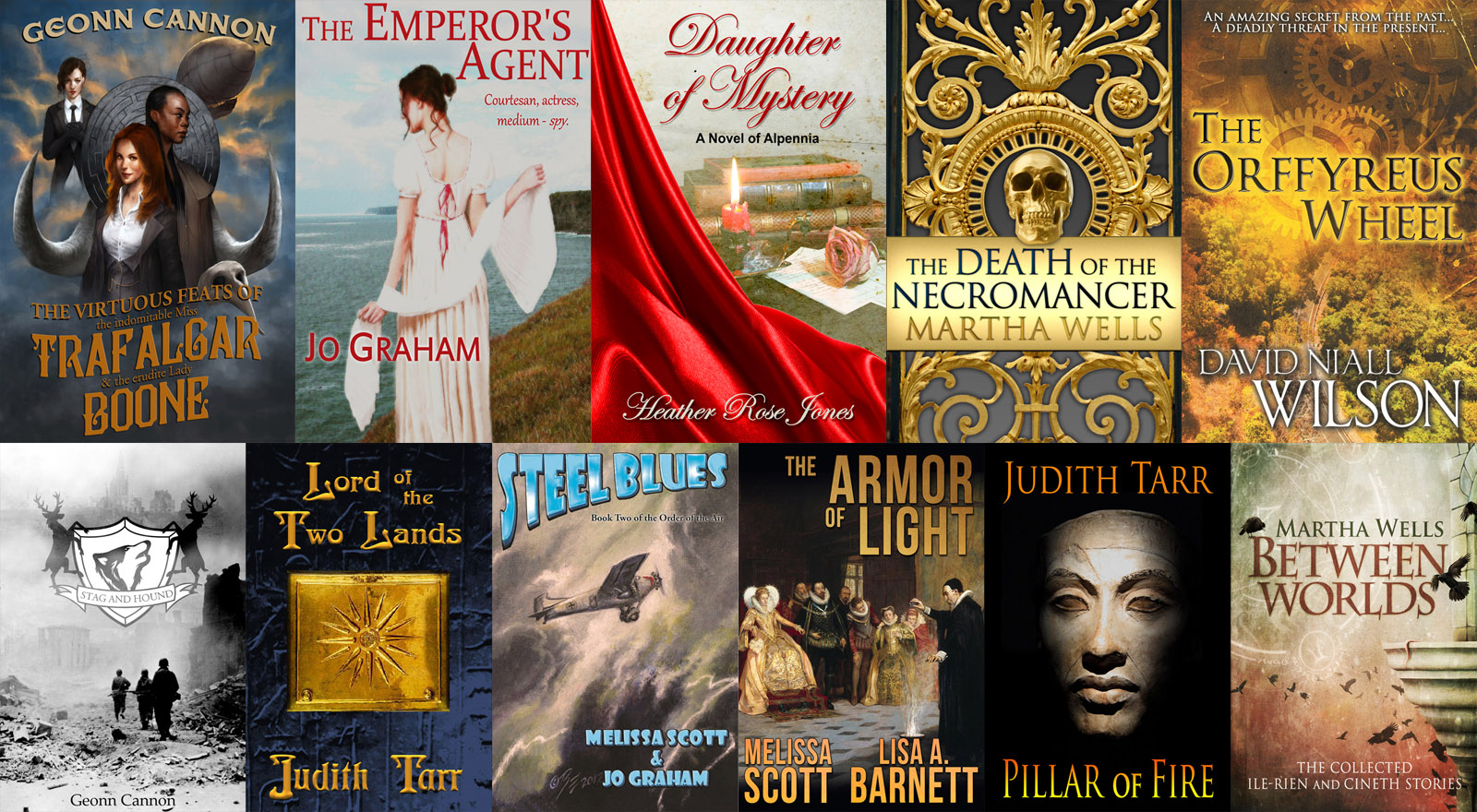
It's just over 48 hours to the end of the Historic Fantasy StoryBundle. A whole collection of magical explorations of the past for an astoundingly affordable price. Now, I suspect that most of my readers have already either bought it or decided not to buy it. But on the off chance that you're still teetering on the edge, here's an incentive. We are in spitting distance of the bundle sales numbers hitting a nice, round arbitrary target. I'm not going to tell you what it is, but I'll tell you if we made it. And if we make that target by the time the bundle offer finishes, I will give away five e-books of The Mystic Marriage, the sequel to my StoryBundle book Daughter of Mystery, to interested parties who bought the bundle. (That part is going to be on the honor system.)
Here's how it works: On Friday morning, if we've made the target, I'll make a post here on the alpennia.com blog announcing it. The the first five interested parties who comment on that post (stating that they bought the bundle) will get a free e-book of The Mystic Marriage. So watch this space, and if you've been wavering, consider it an incentive.
Tuesday, August 9, 2016 - 08:00
Every once in a while, a reader provides an opinion on the Alpenia books that makes me wish my publisher used pull-quotes. A reader posted this on Twitter this morning about The Mystic Marriage: "She has all the girls being competent and intelligent and rounded people. *hugs book* It's Ghostbusters for the Regency set." That goes in my file of "Things to re-read when I worry about whether my books are finding their audience."
One of the things I love doing as I write is to plant random details that may become relevant some day. Quite frankly, I don't always know whether they'll be relevant. And I don't want the reader to be able to tell which ones are foreshadowing and which ones are just part of the background tapestry. Some of them are character details that suggest bits of backstory. In Daughter of Mystery there was a throw-away comment from Aunt Bertrut that, yes, there had been something in her past that she had wanted badly enough to tell the world to go to hell over it, just like the things Margerit wanted. I still don't know exactly what it was, but perhaps some day she'll tell me.
More often it might be a bit of history. A reference to some past event. A description of a building. An object, described and then forgotten. There was one of those mentioned in The Mystic Marriage that comes back to bite Margerit in Mother of Souls, but to say more would be a spoiler. Here's another one, from Chapter 5 of Mother of Souls, providing a suggestion that the social "mystery guilds" prevalent in 19th century Alpennia may have had a much more practical function in the past, when craft guilds were an important part of manufacture and trade. This is a key plot element in a planned independent prequel book about the 15th century philosopher Tanfrit (the subject of the opera in Mother of Souls). The specific object mentioned here is going to be a point of minor interest in a later book, but I'll leave that just as a hint.
* * *
[Margerit and Serafina are preparing for a detailed observation of the Tutela Mystery of Saint Mauriz in Rotenek Cathedral.]
A wistful look came over Serafina, but then something caught her eye and she pointed off toward the base of the donor’s windows where the seats had been placed for the royal family. “What’s happening there?”
Margerit stared where she was pointing. The effects were pale and masked by the light coming through the colored glass. She had never noticed anything odd about the design before, but now that her attention was drawn to it, she could see a thin rain of light drifting down from the fragments of the original window where the saint’s halo encircled the darker glass of his face . The newer portions of the glass only let through mortal light.
“I never noticed that before,” she whispered back. “There’s a legend that one of the glassmakers for the cathedral had set mysteries in the panes, but I never thought what that might mean.” Now that she was looking for it, she could see the fluctus drifting down to the dais where Princess Annek and her family would sit and pooling as it faded there. Some ancient blessing? Or a protection perhaps? Or was it chance that it fell in that spot? Had all the windows trapped fluctus like that at one time? Most were from the renovations in Prince Filip’s day.
“There’s an entire section in the Vatican library on mysteries of the craft guilds,” Serafina whispered. “I never had permission to explore it. A few people still study them, but they say most of the secrets have been lost or were never written down in the first place. If words and prayers can weave a mystery, and art is a prayer of the hands, then why shouldn’t any creation be capable of carrying the living word? I’ve always thought Mesnera Chazillen’s alchemy to have more of mystery than science to it.”
Margerit shook her head. “No, I doubt it. I know that many alchemists combine their work with meditation, but the heart of the practice is different. It must be, for so much of alchemy was learned from unbelievers. A true mystery can only come from God through the saints.”
Serafina gave her an odd sidelong glance. “If you believe that, then there must be many strange and wonderful things in the world that are not true mysteries.”
Publications:
Mother of SoulsMonday, August 8, 2016 - 12:00
There's an exciting new development coming for the Lesbian Historic Motif Project. Yesterday, I delivered the first four episodes for a spin-off podcast based on the Project. At least at first, I plan for a once-a-month schedule until I get a sense of how it fits into my workload and how much suitable material I have. It will be part of an existing "magazine style" podcast, which means I don't have to do my own administration or drum up my own audience. I'm being vague here because I don't want to jump the gun ahead of the podcast owner.
While the blog is organized around reviewing and summarizing specific publications, the podcast will take a more relaxed "human interest" angle. I'll be using it to "tell stories" about the historic and literary figures I've been researching, as well as being a context for presenting some of the original texts: poetry, fiction, plays, legal and historical extracts. I may even manage to do some interviews eventually. So stay tuned for more information!
Full citation:
Crompton, Louis. 1985. “The Myth of Lesbian Impunity: Capital Laws from 1270 to 1791” in Licata, Salvatore J. & Robert P. Petersen (eds). The Gay Past: A Collection of Historical Essays. Harrington Park Press, New York. ISBN 0-918393-11-6 (Also published as Journal of Homosexuality, Vol. 6, numbers 1/2, Fall/Winter 1980.)
Publication summary:
A collection mostly of case-studies of specific historic incidents or topics relevant to the changing understandings of homosexuality. Most of the papers address male topics. Only the three relevant to female topics are covered in this project.
Crompton, Louis. 1985. “The Myth of Lesbian Impunity: Capital Laws from 1270 to 1791”
I had to go back and check several times to make sure I hadn’t blogged this article yet. It gets cited by so many works I’ve studied that it feels like an old friend. This is a foundational article on which many later writers have built, expanding the understanding of why "impunity" is technically a myth to the reasons and circumstances in which the laws might or might not be applied, thus creating the “myth” of the article’s title. That is not to say that this is a happy subject, as the evidence brought to bear concerns women being put on trial and sometimes executed for the crime of engaging in sex together.
Crompton provides an in-depth study of European and American laws addressing homosexual acts between women, from 1270 on. Prior to this study, the general historical understanding was that lesbians were ignored by the law, based mostly on an unwarranted generalization from English law. In fact, lesbian acts were criminalized in legal systems in France, Spain, Italy, Germany, and Switzerland, and were considered equivalent to male sodomy.
Legal prohibitions against female homosexuality in western culture do not date as far back as those against men. Talmud treats the activity as mere “obscenity”. The only passage in the New Testament that has been interpreted as addressing lesbian acts is Paul’s condemnation of women who “change the natural use into that which is against nature,” which later was interpreted as referring to sex between women.
The earliest law that Crompton found unambiguously prohibiting sex between women in a French code of 1270, which, even so, does it in the context of an illogical parallelism with male sodomy. One passage states that a man proved to be a sodomite shall lose his testicles at the first offence, and his “member” (i.e., penis) at the second, with the third offense calling for burning. The following passage notes that “A woman who does this shall lose her member each time.” Crompton suggests this may refer to clitoridectomy (twice?) but it may simply be a nonsensical structural parallel. In literature, burning is the prescribed penalty for “buggery” between women in the early 14th c. French Romance Yde and Olive.
This somewhat extreme shift from indifference to execution seems to have been driven by an elevation of “natural law” by which non-procreative sex acts were considered inherently sinful, rather than (as in Jewish law) being taboo due to associations with pagan practices. And early commentaries on Paul uniformly interpreted his words as applying to lesbian acts
Penitential manuals begin addressing the topic of lesbian sex as early as 670 A.D. (Theodore of Tarsus) and, once introduced, the topic continues to be condemned via works such as Gratian’s Decretum of 1140 which continued in use into the 20th century. Thomas Aquinas’s Summa Theologica (1267-1273) unambiguously condemns “copulation with an undue sex, male with male or female with female,” and specifically associates this with the term “sodomy”.
Classical Roman law began to be revived in medieval Europe in the 11th century via Bologna, and promulgated in particular through the works of Cino da Pistoia and Bartholomaeus of Saliceto in the 14th century. Cino interpreted a law in the Code of Justinian as referring to lesbians, although the main purpose of the law was to exclude rape victims from the category of “unchaste women”. But in noting who counts as “unchaste”, the passage “women who surrender their honor to the lusts of others” is glossed wih the note that a woman may surrender to a man or to a woman. Expanding on this, the gloss notes, “For there are certain women, inclined to foul wickedness, who exercise their lust on other women and pursue them like men.” Bartholomaeus goes further and prescribes the death penalty in this case. The influence of Roman law was such that interpretations such as this might be held to apply even when local law codes carried no similar prohibition or penalty. Roman law was being freshly incorporated into national laws as late as the 16th century in Germany and the 17th century in Scotland.
The question remains whether these laws were carried out in actual practice. Crompton assembles evidence for significant numbers of judicial burnings and hangings of men for sodomy in the 13-18th centuries. Documented prosecutions of women are much rarer. He collates the following cases which are repeated in every subsequent article on this topic:
- Speier (Germany), 1477, a judicial drowning for lesbian acts
- Spain, 16th c, 2 nuns burned for sex with each other using “instruments”
- Bordeaux (France), 1533, Françoise de l’Etage and Catherine de la Manière tried and tortured for sexual acts together, but acquitted for insufficient evidence
- Fontaines (France), 1535, a woman condemned to burn for disguising herself as a man and marrying another woman with whom she had sex
- Marne (France), 1580, a group of seven or eight women disguise themselves to live as men; one became engaged to a woman, then married a different woman, but was recognized by a previous acquaintaince and was condemned to be hanged. The charge included using “illicit devices” for sex.
The law code of the Holy Roman Emperor Charles V (1532) prescribes death by burning for “anyone [who] commits impurity...a woman with a woman.”
The statutes of the Italian town of Treviso expanded on the description of male and female sodomy by noting the common terms for those who commit it: “buzerones” (for men) and “fregatores” (for women).
The standard work on medieval Spanish law, written in 1265, was glossed in 1555 in a way that suggests there was some question whether sodomy statutes applied to women. One commenter argued that lesbian acts were less serious than male ones as women could not “pollute” each other, and therefore might be punished with something less than death. This was clarified by another commenter who fastened on the distinction of whether penetration was involved and prescribed burning if they use “any material instrument”, but a lesser penalty if no instrument is involved.
Russian law of the 17th century also prescribed burning for female sodomy.
The lack of laws against lesbian acts in England was not a general feature of Protestant countries. Calvinist regions of Germany and Switzerland called for severe punishments, and an execution is noted in Geneva (Switzerland) in 1568 of a woman who admitted to sex with women.
Drafters of the first law codes in the English colonies in the New World at first included the death penalty for sodomy whether male or female, but that draft was never implemented. The rare legal cases from New England in the 17th century include a charge against “the wife of Hugh Norman and Mary Hammon” for “lewd behavior each with other upon a bed” but they were sentenced only to a public confession.
In the 18th century, the focus on “instruments” in the commission of female sodomy gave way to the new fascination with the clitoris and the possibility that it might be large enough to enable penetration. In this context, anatomy itself was considered sufficient proof of guilt, whereas “normal” anatomy was considered incompatible with the commission of sodomy. French authorities of the 18th century continued to condemn female sodomy, but no trials for it have been found in that era.
Event / person:
Monday, August 8, 2016 - 08:00
(The StoryBundle is entering its final stretch--only a few more days to go! Today's post is for those of you who might be looking to spice up your steam-punk adventures with some bad-ass women. Based on some reader reactions, "spice up" may be an apt description. It sounds like Geonn Cannon's inspiration process for stories may be similar to my own: start with a vivid and gripping "snapshot" and then figure out who these people are and how they got into that situation. Geonn has two books in the Historic Fantasy StoryBundle. I'm immensely flattered--though rather dubious--that he describes me as a "giant" among such company!)
* * *
A Few Words About Trafalgar & Boone - by Geonn Cannon
This is a story I've told before, but it's a good one. And this will hopefully help people who are coming to my blog because of the Storybundle. To which I say...
One morning, I woke up with a segment of a dream still rattling around in my head. All I had was a single "scene": Two women, one black and one white, covered in mud, blood, dirt, and grime. One was wearing a heavy leather duster. The other was a redhead. They were joined by a man who was looking much more composed than either of the ladies. The three of them stepped into an elevator. As the doors closed, the women looked at each other and started to laugh. The man rolled his eyes, exasperated. Beyond that, I only knew that their names were Trafalgar & Boone.
It was such a strong image that I went to Twitter and sort of off-handedly described it. Three different followers pushed me to do more with the idea, prompting me into making it a steampunk lesbian Indiana Jones analog. Who wouldn't want to write something like that?! I had other projects on the table at the time so I set it aside, but I kept coming back to it. Eventually I had to start writing, and the world of Trafalgar & Boone unfolded around me. It was a world just emerging from a Great War, which had been fought with magic. It was a London with airships ferrying passengers across the Thames. And it was a world on the brink of something horrible wrought by the overuse and unpracticed use of magic during the war. Strange and powerful things are afoot in the world, and only by two former enemies joining forces can anyone hope to survive.
Since being published, Trafalgar & Boone have been the recipient of several honors from Kirkus Reviews. It was given a rare starred review, named one of their best Indie books of the month, and one of the best indie books of 2015. The covers, by Rita Fei, are so spectacular that I don't know how I lucked into getting her to do them. I'm trying not to create plots simply to see what she can do for them.
Melissa Scott has been a champion for Trafalgar and Dorothy Boone from the moment they were conceived, and I'm honored she chose to include them in this Storybundle. They're taking a position among such giants as Jo Graham, Martha Wells, Heather Rose Jones, and Judith Tarr. For less than the price of any individual books, you get FIVE great novels. And if you decide to pay a little extra, you more than double your haul.
With your purchase, you're not just supporting creators, you can help charity at the same time. You can donate a portion of your payment to Mighty Writersand Girls Write Now. So go! Pretend you're being selfish in grabbing some great reads and help support young writers at the same time! The Storybundle is only going to be available for a limited time, so get yours now!
Major category:
Guest PostsPages

Tags
2018 Fiction Series (5)
2019 Fiction Series (8)
2020 Fiction Series (6)
2021 Fiction Series (6)
2022 Fiction Series (7)
2023 Fiction Series (5)
2024 Fiction Series (5)
2025 Fiction Series (6)
2026 Fiction Series (3)
2027 Fiction Series (1)
admin (2)
A Little Princess (36)
All is Silence (1)
Alpennia (24)
audiobooks (2)
awards (9)
BayCon (4)
Best Related Work (18)
Bonus Fiction (2)
book intake (11)
Book Release Re-Boot (33)
Bookstore Event (1)
Cats (1)
Clothing (1)
conventions (36)
cookery (1)
cover (1)
Diana's Band (1)
FAQ (7)
Floodtide (48)
FOGcon (3)
Garden (2)
Gaylactic Spectrum (1)
Gifts Tell Truth (4)
giveaways (5)
guest-blog (9)
Gwylan (1)
Hoywverch (1)
Hyddwen (2)
Interview (6)
Kalamazoo (66)
Lace and Blade (3)
LaForge (27)
language (1)
Lesbian Book Bingo (10)
LHMP (1061)
Mabinogi (1)
MAC2 (1)
Merchinogi (2)
Mistress of Shadows (2)
Mother of Souls (2)
Music (1)
names (1)
newsletter (3)
New Zealand (1)
Numbers (1)
Patreon (2)
Philosophy (7)
podcast (404)
Podcastle (1)
Poetry (1)
promotion (87)
publication (1)
publishing (4)
QSF (3)
representation (1)
Research (3)
reviews (4)
Reviews: audio (7)
Reviews: Books (145)
Reviews: graphic novels (5)
Reviews: Live Performance (7)
reviews: movies (36)
reviews: non-fiction (6)
reviews: short fiction (2)
Sale (6)
Sirens (1)
Skin-Singer (2)
Skinsinger (3)
stories (1)
Storybundle (16)
submissions (2)
teasers (52)
test (2)
The Language of Roses (2)
the language of roses (6)
Through the Hourglass (1)
transcript (8)
travel (8)
Updates (1)
Where My Heart Goes (2)
Wizards vs Lesbians (1)
Work (1)
Worldcon (11)
Worldcon75 (13)
Worldcon 76 (1)
Worldcon 77 (12)
writing (55)
Year-End Summary (10)


